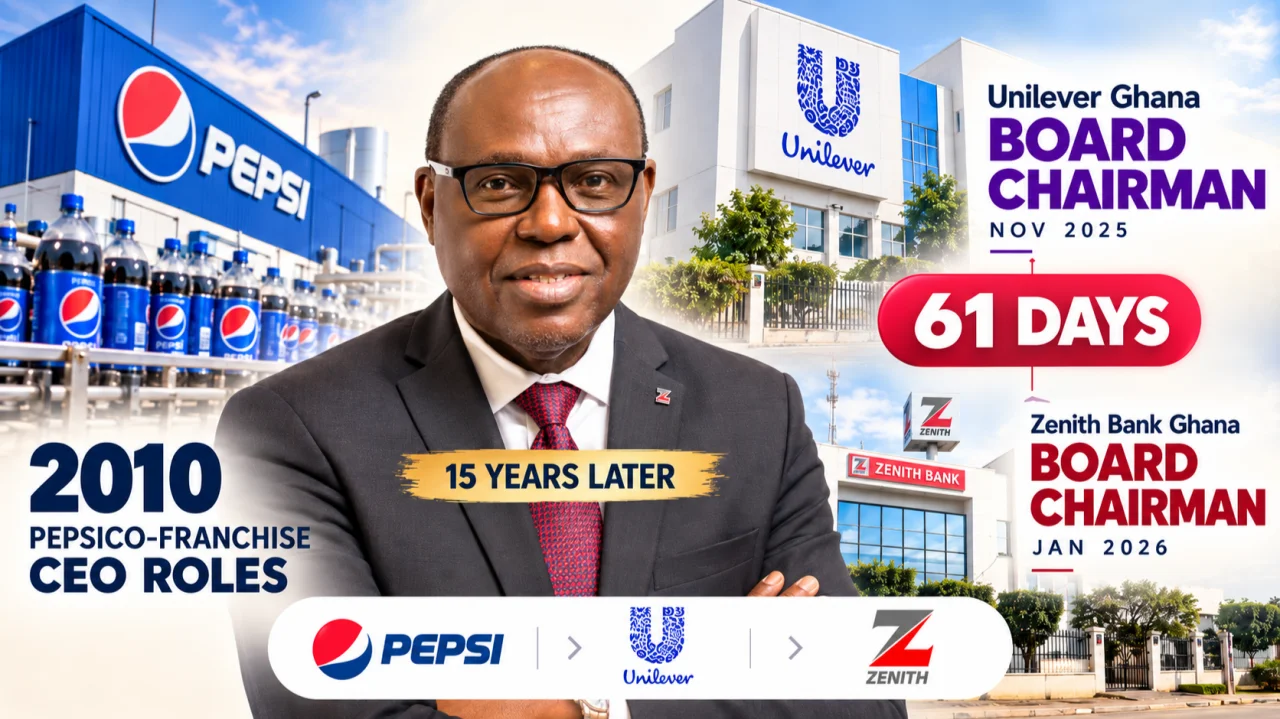
In 2010, Charles Boakye Nimako stepped away from two CEO roles.
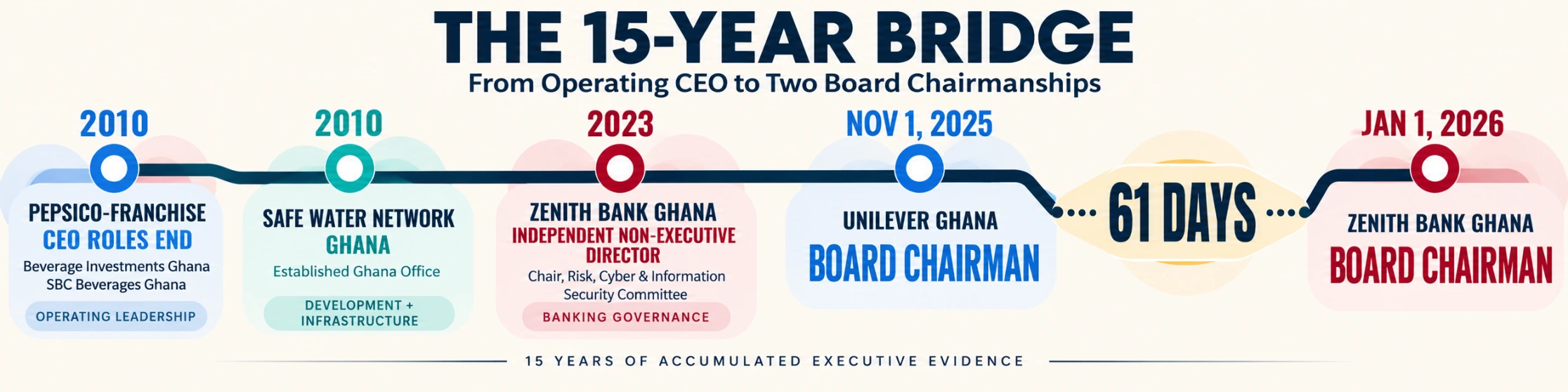
He had been Chief Executive Officer of Beverage Investments Ghana Limited and SBC Beverages Ghana Limited, both PepsiCo franchise holders.
His PepsiCo-franchise career had also included Sales and Marketing leadership in Ghana, franchise responsibility across Kenya, Uganda, and Ethiopia, and work on a PepsiCo franchise operation in Angola.
Then in May 2010, he opened the Ghana office of Safe Water Network.
The CEO chapter was over, and if you were looking at his career from the outside, you could easily have assumed the obvious next chapter would eventually be another operating CEO role.
It wasn't.
Fifteen years later, something much more interesting happened.
On November 1, 2025, Charles Boakye Nimako became Board Chairman of Unilever Ghana PLC.
Then, on January 1, 2026, just 61 days later, he became Board Chairman of Zenith Bank Ghana too.
Consumer goods and banking, but the same Chairman.
I think the 15 years between those two parts of his career are more important than the titles themselves.
The 15 Years Between CEO and Chairman
Here's what Charles did not do after leaving those PepsiCo-franchise CEO roles.
He did not simply disappear for 15 years and re-emerge with two chairmanships.
He moved into an entirely different problem, safe water.
In May 2010, he established Safe Water Network's Ghana office, bringing private-sector experience into a market-based approach to providing safe and affordable water.
He remains involved with Safe Water Network today as its Africa Initiatives Lead.
But that wasn't the only thing happening.
In 2023, Zenith Bank Ghana appointed Nimako to its board as an Independent Non-Executive Director, and not just as another name sitting around the table.
He became Chair of the bank's Risk, Cyber, and Information Security Committee.
Bank of Ghana approval for his board appointment was granted on March 30, 2023.
Think about the progression for a moment.
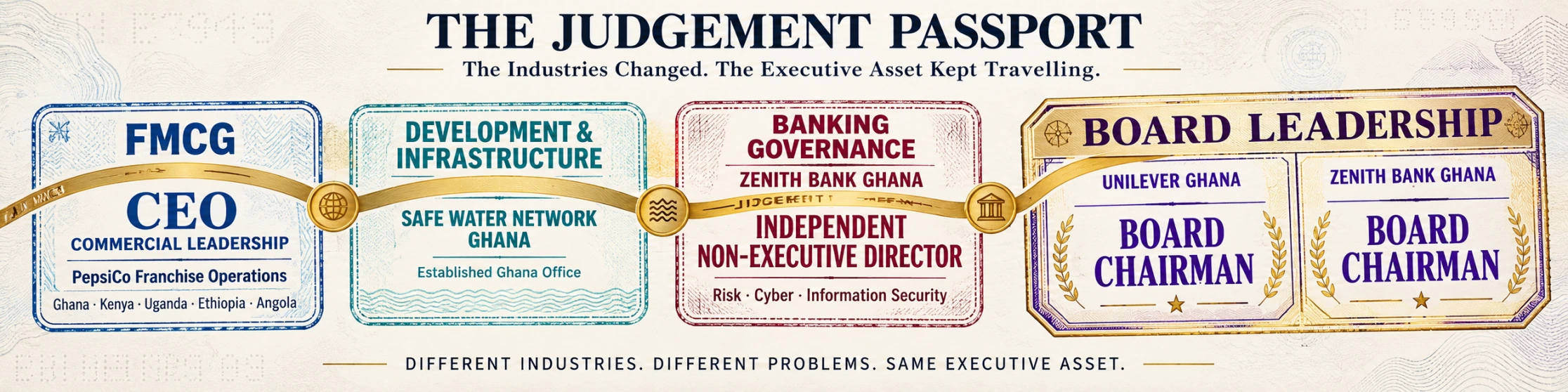
CEO, then development and infrastructure work, then Independent Non-Executive Director, then responsibility for risk, cyber, and information security oversight inside a bank, then Unilever Ghana Board Chairman, then Zenith Bank Ghana Board Chairman.
That doesn't look like someone protecting one narrow professional identity.
It looks like an executive career becoming useful in progressively different settings.
The Asset That Crossed Industries
There's something senior executives spend decades building without always naming it.
Judgement, not technical knowledge alone, not the title, not the size of the office, not how many people reported to you.
The accumulated ability to look at a situation, recognise what matters, challenge what doesn't make sense, and make decisions when the information is incomplete.
And just so you know, I'm not claiming we know every private consideration behind either board appointment.
We don't.
But Zenith told us something very useful when it announced Charles as Board Chair.
The bank specifically pointed to his leadership across diverse industries, his strategic insight, and his deep understanding of governance.
Unilever's announcement similarly described him as a global business executive with more than 30 years of experience across blue-chip organisations.
That language matters.
Zenith didn't describe him only as "the former CEO of a PepsiCo franchise."
It described an executive whose usefulness had become broader than the industry in which he once operated.
The Career Before the 15 Years Matters Too
Charles didn't begin building that breadth in 2010.
Long before the two chairmanships, his career had already crossed very different environments.
He worked with McKinsey & Company in Johannesburg and London.
Before that, he worked with Coopers & Lybrand, now PwC, in Los Angeles, and Great Western Financial Corporation in Beverly Hills.
Then came Ghana and PepsiCo-franchise operations, multi-country responsibility across Kenya, Uganda, and Ethiopia, then Angola, then Safe Water Network, then banking governance, then Unilever Ghana, and then Zenith Bank Ghana.
He also holds an MBA from Stanford Graduate School of Business and is a Certified Public Accountant.
There's a pattern in there.
His career didn't keep proving the exact same thing in increasingly senior job titles.
It kept exposing his judgement to different problems, and I think that's where this gets very interesting for senior executives.
CEO Credibility and Board Credibility Are Not the Same Thing
A CEO is responsible for operating, customers, people, revenue, execution, and strategy; the machinery has to move.
A board has a different job: oversight, challenge, risk, governance, strategy, and holding management accountable without becoming management.
Which means being an excellent CEO does not automatically make somebody an obvious board candidate.
And being excellent in one industry doesn't automatically explain why another industry should want your judgement.
That bridge still has to be built.
Charles's career gives us an unusually visible example of what that bridge can look like.
He had already run businesses, but by the time Zenith made him Chairman, it had also seen him operate inside its own governance system for almost three years as an Independent Non-Executive Director and committee chair.
That's evidence, not aspiration, and there's an enormous difference between the two.
The Mistake Nobody Makes on Purpose
Here's what happens to a lot of successful senior executives.
You become excellent at the thing immediately in front of you, running the business, delivering the transformation, hitting the numbers, managing the team, deepening your industry knowledge.
Because those things keep rewarding you, you understandably keep doing more of them.
The next role gets bigger, then the next one, and eventually you become so strongly associated with one company, one sector, or one operating identity that the market struggles to imagine you anywhere else.
I get it, as no one plans for that to happen.
It's simply the natural consequence of spending 20 or 30 years becoming very good at one kind of success.
But, and it's a big one, the higher you go, the more valuable it becomes for people to understand the quality of your judgement separately from the environment in which you first proved it.
Because your next opportunity may not look like your current job.
It may not even be in your current industry.
The Difference Between Experience and Portable Experience
This is where I think senior executives need to make a distinction.
You can have extraordinary experience that is difficult for another institution to interpret, or you can have extraordinary experience whose relevance is obvious even when the logo above the door changes.
Those are not the same thing.
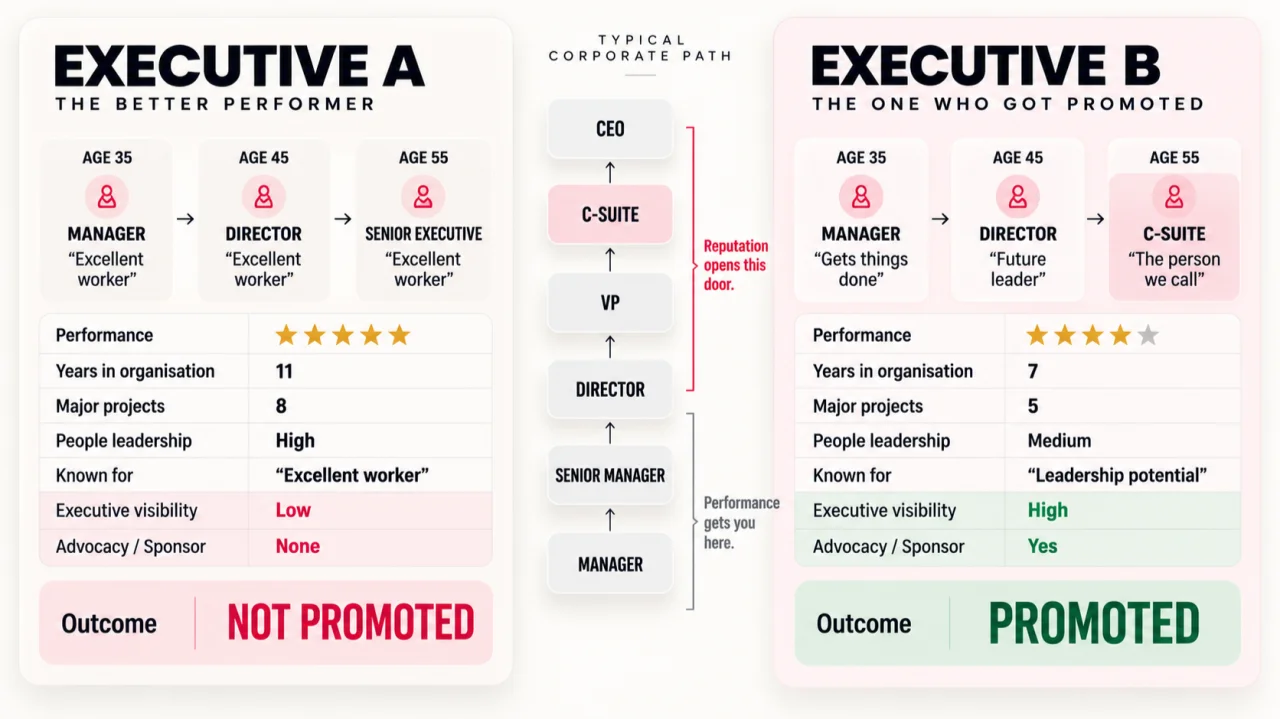
Imagine two CEOs.
Both have run successful organisations for 15 years, both have grown revenue, both have managed thousands of employees, both have survived difficult economic periods.
CEO A explains everything through the organisation:
"At Company X, I ran Division Y, managed Z people, and delivered these numbers."
All impressive.
CEO B can also explain the decisions underneath those numbers, how they judged risk, allocated capital, challenged management assumptions, entered unfamiliar markets, handled governance failures, built leadership teams, and made consequential decisions with imperfect information.
Now put both of them in front of a board in an industry neither has operated in before.
The second executive is easier to understand, not necessarily because they're better, but because the value of their experience has been translated into something that travels.
What This Means for Your Brand
You might be thinking, "Karen, I'm not trying to chair Unilever Ghana and Zenith Bank Ghana. What does this have to do with me?"
A lot, actually.
The principle starts long before somebody offers you a chairmanship.
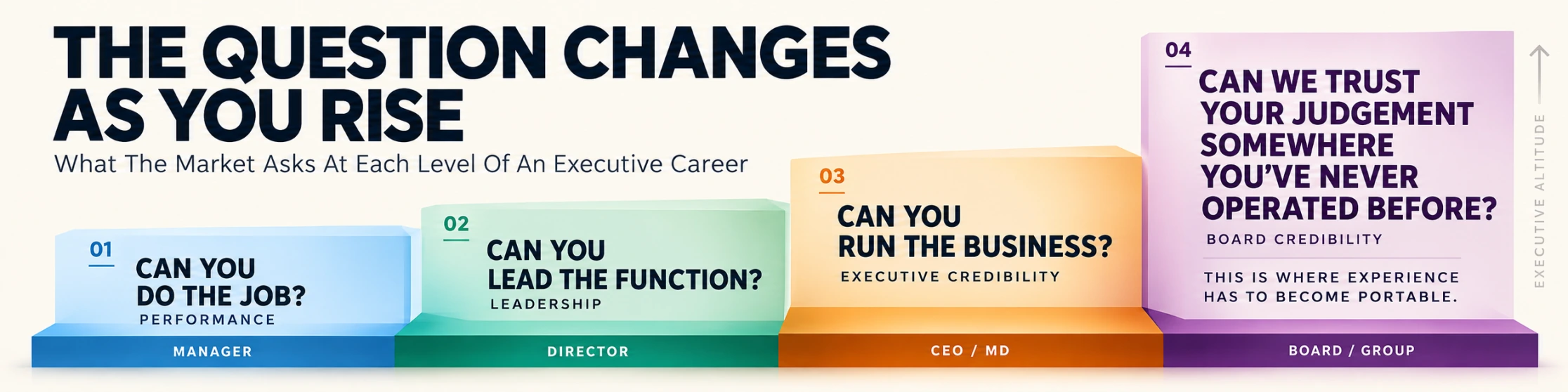
At some point in a senior executive career, the question changes.
Early on, people want to know, can you do the job?.
Later, can you lead the function?
Then, can you run the business?
But eventually, another question begins to matter:
Can we trust your judgement somewhere you've never held an operating title before?
That's an entirely different reputation problem, and your CV doesn't answer it.
Neither does your title nor twenty-five years in the same industry.
What begins to matter is whether there's enough evidence around your name for people to understand the kind of judgement you bring.
Your decisions, your results, your governance experience, the problems people trust you with, the boards and institutions that have already trusted you, the ideas you're publicly associated with, and the people who can describe your value when you're not around to describe it yourself.
That's when an executive reputation stops being attached only to a job and starts becoming portable.
The Boardroom Test
Here's a useful test.
Remove your current employer from your professional story.
Remove your title too.
Now ask:
What is left that another Board Chairman, Group CEO, or Nomination Committee could evaluate?
What evidence exists of your judgement?
What decisions are attached to your name?
What have you governed, as opposed to simply operated?
What problems have people trusted you to solve outside your immediate job description?
And most importantly, would any of that still make sense to somebody in another industry?
If the answer is difficult to articulate, that doesn't erase the career you've built.
It simply tells you where the reputation infrastructure is still incomplete.
The Uncomfortable Question
If your CEO or MD title disappeared tomorrow, would another industry know what your judgement is worth?
And I’m not talking about your employer's reputation, your job description, or the size of the team you currently manage.
I’m talking about Yours.
And if another board looked at your career today, would they see an excellent operator from one company, or somebody whose judgement they could trust somewhere they've never worked before?
Positioning Clarity is Pillar 1 of the Magnetic Brand Audit because seniority eventually requires more than telling people what you do.
It requires making clear what people should trust your judgement on, even when the company and industry change.
Trust Infrastructure is Pillar 3 because board-level reputation cannot survive on claims alone.
It needs evidence, results, institutional credibility, third-party validation, governance responsibility, a track record other people can independently verify.
Charles Boakye Nimako left his PepsiCo-franchise CEO roles in 2010.
Fifteen years later, Unilever Ghana made him Board Chairman.
61 days after that, Zenith Bank Ghana made him Board Chairman too.
Maybe the real story is that somewhere along those 15 years, his professional value grew larger than the industry where he first proved it.
Reply "Audit," and I'll send over the highly coveted Magnetic Brand Audit.
(Only for those who don't believe in chasing but in becoming magnetic to their target audience.)
Because eventually, the senior executive game changes.
The question stops being "how high can I climb inside this company" and becomes "how far can my judgement travel once I leave it."
Talk soon,
Aunty Karen
(Your Favorite)
P.S. Charles left the CEO seat in 2010. Fifteen years later, two major companies put his name at the top of their boardrooms within 61 days.