Your career moves through decades, 30, 40, and 50, and your reputation is supposed to move with it.
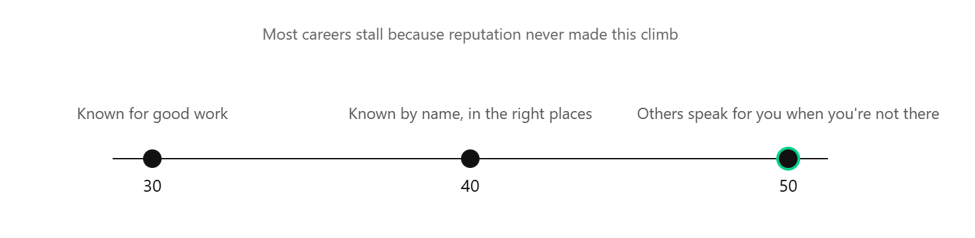
Unfortunately, most of the time, it doesn't move the way we assume it will.
I've spent more than 35 years alongside senior executives, and somewhere in that time I’ve witnessed over 100 promotion meetings.

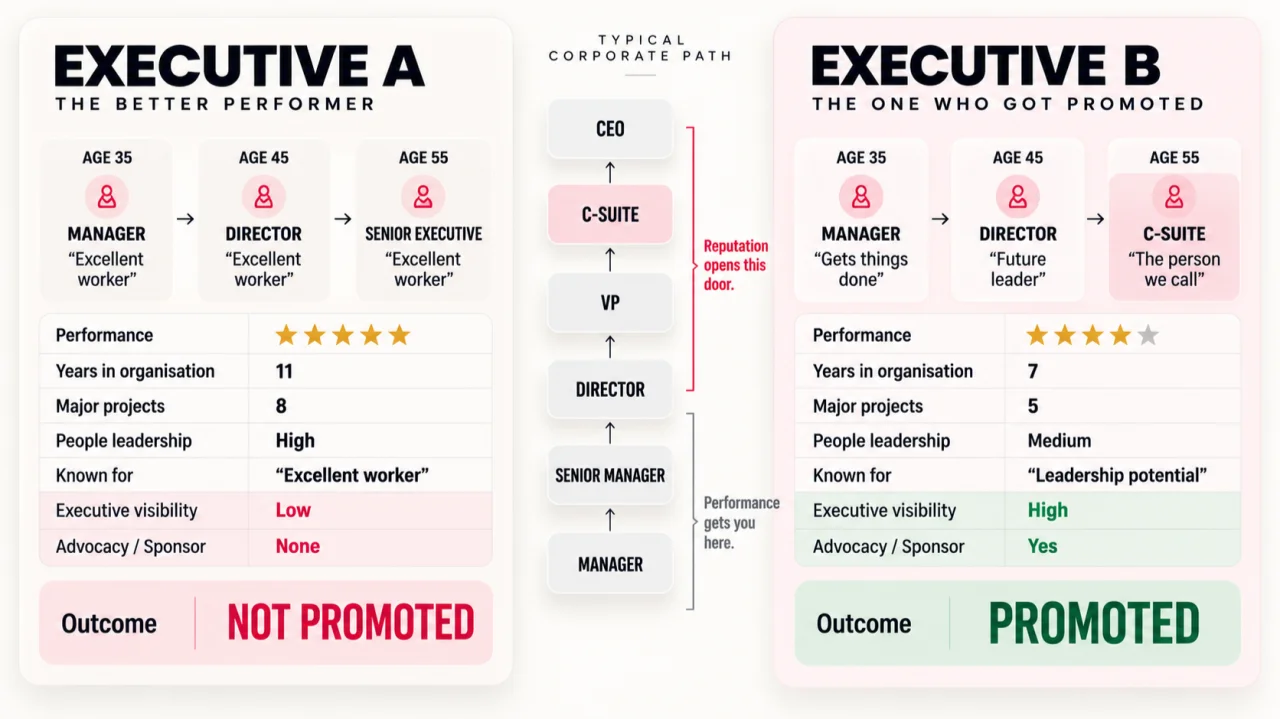
I watched average players get promoted and saw some of the best people I've ever worked with get quietly sidelined, again and again, for reasons that had nothing to do with how good their work was.
Eventually I had to stop assuming the process was fair and start asking the hard question.
“What is actually causing interview panels to decide the way they do?”
Here's what 35 years of watching this has taught me.
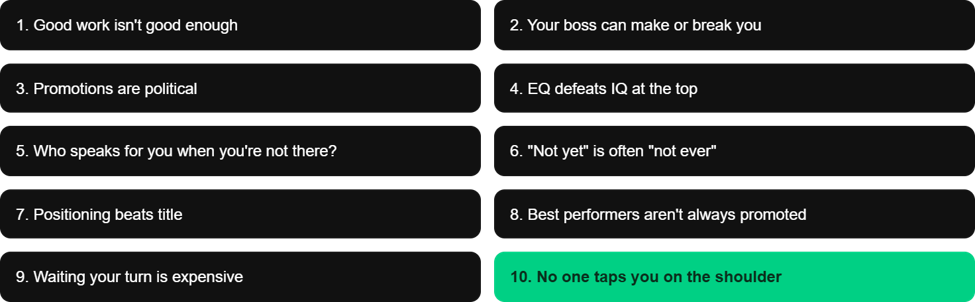
Ten truths, and one first step for each, because a truth without an action is just something to feel bad about.
1. Good work isn't good enough.
Nobody tells you this early enough that doing excellent work is the entry fee, not the differentiator.
First step: Write, in one sentence, what you want your reputation to say about you when you're not there to speak for yourself. Check whether your current visible work actually supports that sentence.
2. Your boss can make or break your promotion.
Not the panel, not HR, the person you report to, and specifically, how willing they are to advocate for you when you're not there to advocate for yourself.
First step: Have one direct, uncomfortable conversation this quarter, asking your boss plainly what they'd say about you when speaking on your behalf.
3. Promotions are political. Pretending they're not is expensive.
Calling it politics doesn't make you cynical; it makes you accurate.
First step: Map the actual decision-makers for your next move, not the org chart, and name at least one you don't yet have a real relationship with.
4. EQ defeats IQ at senior levels.
By the time you're competing for the top seats, every other person in contention is smart. The differentiator is how well you read and manage people.
First step: Ask one trusted colleague, bluntly, how you come across under pressure. And I’m not talking about your work but about you.
5. Who speaks for you when you're not there to speak for yourself?
Decisions about you get made in conversations you're never invited to.
First step: Name the person. If you can't name one person clearly, that's your answer right there. And it’s got to change.
6. "Not yet" is frequently "not ever" in disguise.
Learning to tell the difference is a skill most people never develop.
First step: Next time you hear "not yet," ask directly what specifically has to be true for "yet" to arrive, and by when. A vague answer is the answer.
7. Your title doesn't capture your value. Your positioning does.
Your positioning shapes how your value is understood far more accurately than your title ever will.
First step: Write your own one-line positioning statement, then compare it honestly to how you were actually introduced the last time it mattered.
8. The best performers don't always get promoted.
Performance and promotion are correlated, not identical.

First step: Separate your performance review from your promotion case. Build the promotion case as its own document, on its own evidence, this month.
9. Waiting your turn is the most expensive career strategy.
Advancement rewards the people actively building a case for themselves, not the people politely standing in line.
First step: Identify the one ask you've been postponing because it felt too soon, and set a date this month to ask it anyway.
10. No one is coming to tap you on the shoulder.
There is no guaranteed moment where someone finally notices your quiet excellence.
First step: Stop waiting for the invitation. Ask directly, within the next two weeks, for the thing you want from the person who can actually give it.
What This Means for Your Brand
You might be thinking, "Karen, this is about corporate promotions. What does this have to do with building a brand?"
Everything, actually.
Example 1: A senior executive has spent a decade doing consistently excellent work, assuming that eventually the right people will notice and the right opportunity will open. Nobody is speaking for them when they're not there, because nobody outside their immediate team actually knows what they've built. Their work is great, but their positioning never existed.
Example 2: A founder builds a strong business and waits for word of mouth to eventually carry their reputation to the people who matter. Meanwhile, a less accomplished competitor is actively naming their own value, showing up where it counts, and getting the recognition the quieter founder actually earned first.
Example 3: A senior executive quietly resents a peer who got promoted over them, convinced it was pure favouritism, while never once auditing whether they themselves ever clearly asked for the role, named their case, or built a relationship with anyone on the panel deciding it. The politics happen whether you like it or not. So was the complete absence of any campaign on their own behalf.
Example 4: A founder insists they're "letting the work speak for itself" while watching a less talented competitor collect the stage invitations, the press mentions, and the introductions they were never offered. The founder calls this integrity. Frequently it's strategy avoidance wearing principle as a disguise, and the market has no way of telling the difference between quiet excellence and no excellence at all.
All four describe the same truth from this list, playing out in a different setting.
Good work, on its own, was never going to be good enough.
Which truth hit hardest?
Tell me the number in the comments.
I read all of them.
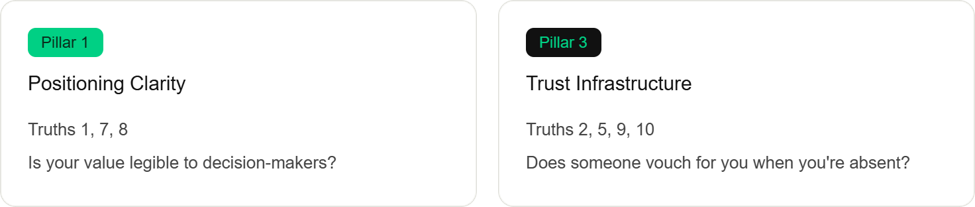
Positioning Clarity is Pillar 1 of the Magnetic Brand Audit, because it asks whether your value is actually legible to the people deciding your next move or whether you're relying on them to figure it out on their own.
Trust Infrastructure is Pillar 3 because it asks whether anyone is actually willing to speak for you when you're not there to speak for yourself and whether you've built anything that makes that advocacy easy for them.
Nobody is coming to tap you on the shoulder.
The good news is you were never actually supposed to wait for that.
Reply "Audit," and I'll send over the highly coveted Magnetic Brand Audit.
(Only for those who don't believe in chasing but in becoming magnetic to their target audience.)
Because 35 years alongside senior executives taught me one thing above all the others.
People reward the person they already know how to talk about, not the best-kept secret sitting quietly in the background.
Talk soon,
Aunty Karen
(Your Favorite)
P.S. Of all ten, number 10 is the one I still watch land hardest on people, every single time. It's the one everyone secretly hoped wasn't true.