I have been watching the same pattern repeat for the past two years, and it is starting to bother me more than I let on.
A founder comes back to Ghana after eight, ten, or fifteen years in London, Toronto, or Houston.
They understand LinkedIn.
They know how to create content.
They show up consistently, post thoughtfully, and build a following that any local executive would envy.
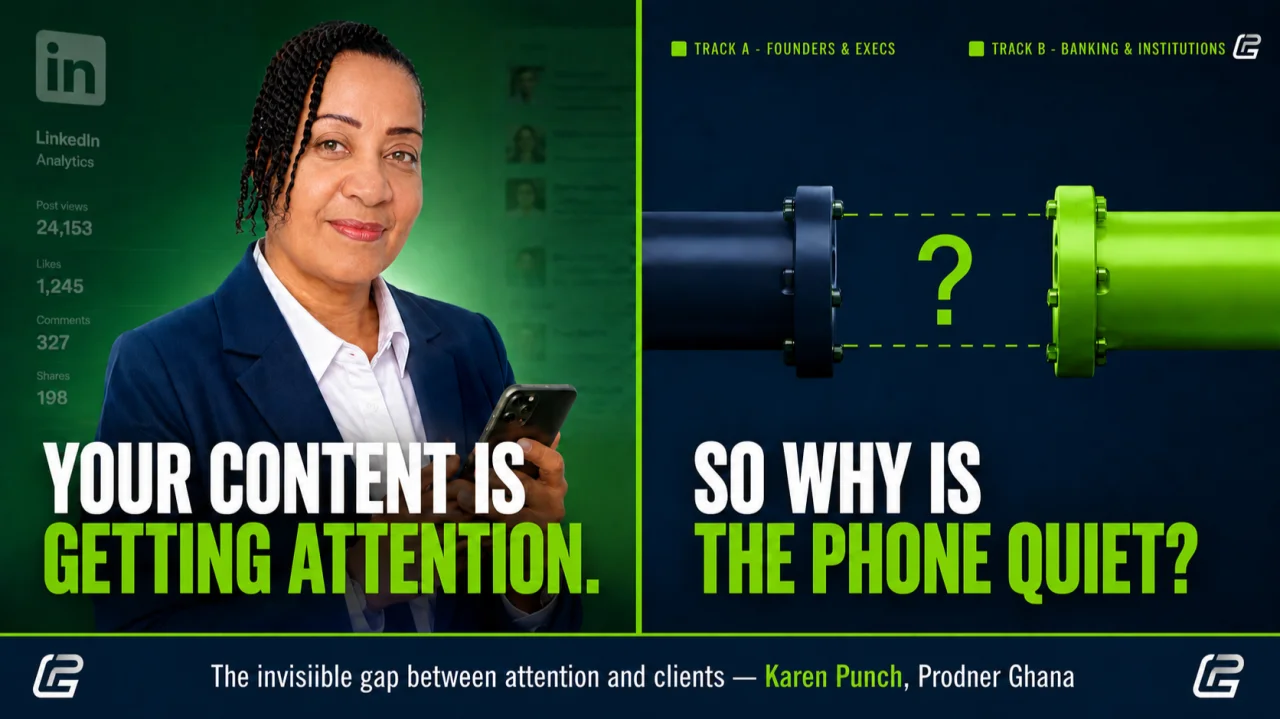
And then the phone stays quiet.
The likes come.
The comments come.
The connection requests come, mostly from people in the same diaspora communities they already know.
But the Ghanaian CFO they want a meeting with never reaches out.
The local bank they want as a client never calls.
And Corporate Ghana is watching from a distance and not moving.
So, the founder posts more.
They increase their frequency, try different formats, and share more personal stories.
Essentially, they’re chasing the algorithm.
Still, the Ghanaian corporate market sits unmoved.
The Attention Trap
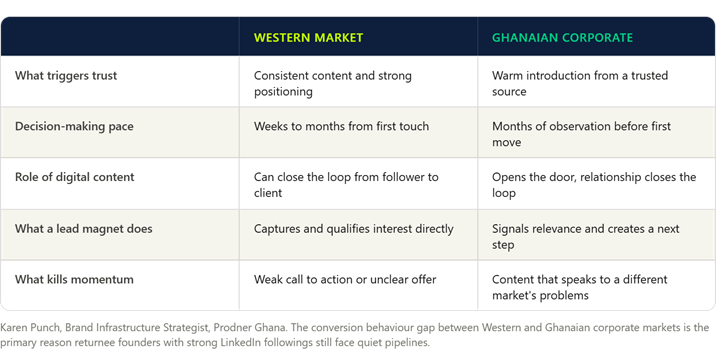
In Western markets, consistent LinkedIn content often creates enough familiarity for a prospect to reach out directly.
The culture of inbound is more established and decision-makers are more comfortable acting on a digital signal.
A well-positioned profile, a strong post, and a clear offer can move someone from follower to conversation in a matter of weeks.
But Ghana works differently.
Your ideal client here is watching carefully.
They have been watching for months, possibly longer.
They have read your posts.
They may have shown them to a colleague.
They know who you are and they respect what you do.
But they are waiting for something your content alone cannot provide.
They are waiting for a reason to trust you that comes through a channel they already trust.
In Ghana, attention opens the door, but relationships are what walk you through it.
The distance between someone knowing your name and someone picking up the phone to call you is bridged by introduction and by the warm signal from someone already inside the circle they operate in.
Your content earns you recognition.
But the bridge converts recognition into conversation.
Most returnee founders earn the recognition and then wait for everything else to follow.
That waiting is where the pipeline dries up.
What the Gap Actually Looks Like
When I audit the brand infrastructure of a returnee founder struggling to crack the local market, I find the same things every time.
The LinkedIn profile is polished and speaks fluently to a Western audience.
The positioning language is clean and global.
The case studies, where they exist, reference international clients and frameworks that land well in London and fall slightly flat in Accra because they signal fluency in a market that is not this one.
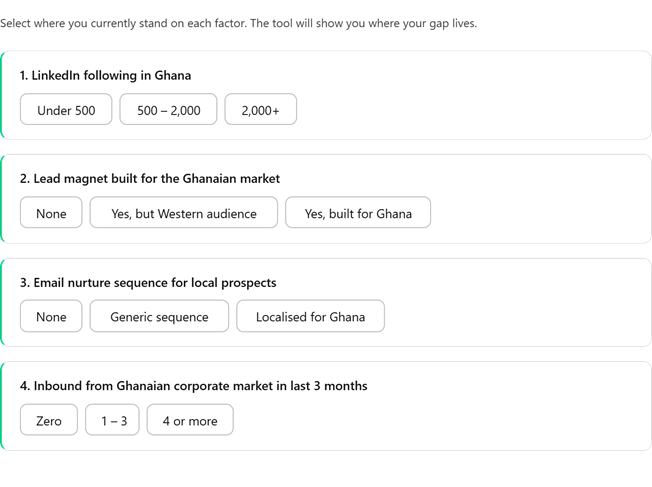
There is no lead magnet that speaks to a specifically Ghanaian problem.
There is no email list being built from the local market.
There is no sequence nurturing a Ghanaian prospect from follower to conversation over time.
And most critically, there is no strategy for moving interested prospects off LinkedIn and into a direct relationship before they go cold.
Here is what happens in practice.
A senior executive in Accra sees your post on a Thursday morning.
It resonates deeply.
He then asks his EA to find out more about you.
So, she looks at your profile, finds a website built for a different market, and sends her boss a link.
He looks at the website, sees nothing that speaks to the problem on his desk this week, and moves on.
You never knew he was there.
What Bridges the Gap
Building a lead capture system for the Ghanaian corporate market requires a deliberate shift in how you think about your content's job.
Your content is not supposed to close the deal or explain your full methodology.
It is supposed to create enough curiosity that the right person wants to take one small step closer.
And that small step?
It needs to be designed on purpose.
It could be a lead magnet addressing a specific problem your Ghanaian ICP is sitting with right now.
A specific diagnostic or resource that speaks to a challenge they recognize from their own Monday morning, written in the language of this market, not the last one you worked in.
It could be a short email sequence nurturing someone who downloads that resource, showing them your thinking, your results, and your understanding of their world over several weeks, at a pace that respects how the Ghanaian corporate market actually makes decisions.
It could be a private briefing, small group, invite-only event that moves interested prospects from passive observers to active participants in a conversation you are leading.
Any of these bridges the gap between the attention your content creates and the conversation your business needs.
Without at least one of them, you are collecting followers in a market that was never going to convert from a LinkedIn post alone.
What This Means for Your Brand
You might be thinking, "Karen, I have a lead magnet. I have an email list. I tick these boxes."
You may well do.
The question is whether those assets were built for the market you are trying to crack right now.
A lead magnet built for a Western audience will attract a Western audience.
An email sequence written in the language of London consulting will resonate with the Canary Wharf executive and land differently with the Accra one.
The infrastructure needs to speak to this market's specific problems, specific context, and specific pace of decision-making.
That localization is about which problem you are naming, whose reality you are acknowledging, and whether the next step you are offering is easy enough for a busy Ghanaian CFO to take without it feeling like a commitment.
Lead Capture and Nurture is Pillar 4 of the Magnetic Brand Audit.
It is the pillar that determines whether your brand is capturing the interest your content creates or losing it the moment someone steps off the LinkedIn feed.
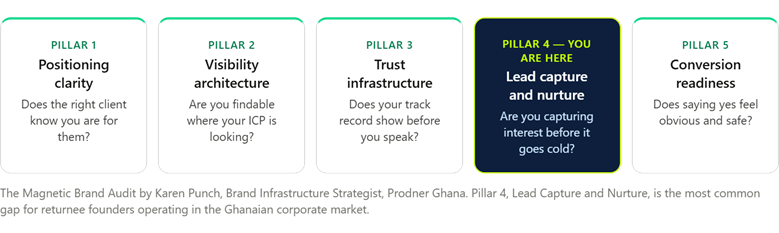
If you are building visibility in Ghana and the phone is still quiet, Pillar 4 is almost certainly where the gap lives.
Reply "Audit" and I'll send it over.
Because the Ghanaian corporate market is watching you carefully and waiting for a reason to move.
Your job is to build the bridge that gives them one.
Talk soon,
Aunty Karen
(Your Favorite)
P.S. The returnee founders who crack the Ghanaian corporate market fastest are almost never the ones with the largest LinkedIn following. They are the ones who figured out earliest that recognition in this market is where the conversation starts, not where it ends.